Counting the Virtues of Bassoon Reed Cane
By James B. Kopp
James Kopp & Associates
All bassoonists who have ever made reeds agree on a basic difference between “good” cane and “bad” cane. When two reeds are identical in design, manufacture and condition, the one that responds well is made of “good” cane, while the mediocre or worse reed is made of “bad” cane.
Consensus breaks down, sad to say, after that one declaration. Discussing the matter, Player A says he prefers “older” cane. B says she doesn’t care about the age, as long as the cane is “hard enough.” C says that he looks for “cane with a close grain,” while D says she knows a good piece of cane “by the color.” E prefers French cane to all other types, while F prefers cane only from selected “vintages” or harvests. Are these reed makers really talking about six different qualities? Is each of these qualities a necessary or sufficient marker of desirable cane? Are still other qualities also important?
These are reasonable questions to ask, but the answers are far from obvious. Edwin V. Lacy recently offered a useful enumeration of some of the different qualities that may contribute to the vibratory characteristics of reed cane.1 His list included “hardness, stiffness, resiliency, density, flexibility,” and a quality to be assessed by a “dynamic” test. (A physicist would call this last quality “resonant frequency.”) Some other bassoonists might have added to Lacy’s list. Lawrence Intravia identified a quality he called “recovery.”2 Numerous other authors have mentioned color, straightness of grain, texture, and “feel under the tool.”
Lacy raised a second important idea, that of possible correlation between distinct characteristics. In other words, certain characteristics – hardness and density, to use Lacy’s example – may be conceptually separate, but may tend to occur together in reed cane. A further wrinkle is that two characteristics may both be thought necessary for “good” reeds, but not be correlated in the broad supply of available cane. James V. Poe recently made this argument for another pair of characteristics – hardness and flexibility.3
Having in mind this quick overview of the reported virtues of basson reed cane, we can ask two useful questions: (1) Are any of these cited qualities in fact synonyms or antonyms for one another, or are they conceptually distinct? (2) Even if certain qualities of cane may be distinguished from one another in concept, do they nevertheless occur in correlation with one another?
A third question we might ask concerns the aging of reeds. Even a good reed changes with age, eventually reaching a point where its response is no longer “good” or dependable. It is reasonable to ask: (3) What changes come about as reeds age, and are these changes related to the qualities that distinguish “good” new reeds from “bad” new reeds?
In seeking to answer these questions, we can draw on the observations of three kinds of experts. The first group will be scientists – botanists, chemists, and physicists – who have commented on the unique vibratory characteristics of Arundo donax, its water-absorbing ability, the anatomical differences between desirable and undesirable cane, etc. The second group will be cane growers, both commercial and individual, who have provided details about the agriculture, harvesting, and curing of the cane. Having this background, we will be well prepared to review the qualities that bassoonists, our third group, have cited as desirable in a “good” piece of Arundo donax.
The following account has been narrowly tailored to include only answers to the questions asked above. For further details of scientific knowledge, agricultural practices, or reed makers’ wisdom, the reader should refer to the sources cited here, among others.
1. The Anatomy of Arundo Donax
One fundamental requirement of a bassoon reed is that it have both a tube and blades, which is less simple than it sounds. Among naturally occurring and easily workable materials, it is surprisingly rare to find a substance that can provide both features. Until modern times, it seems, only cane – with its composite structure – had the necessary strength to form a stable tube, coupled with the necessary flexibility, when scraped, to readily form a bassoon reed.4
A team led by the botanist Peter Kolesik described the composition
of a stem of Arundo donax as comprising three concentric rings: (1) a
hard waxy epidermis and outer cortical cells, (2) a thick sclerified fiber
band, and (3) a thick inner cortex.5
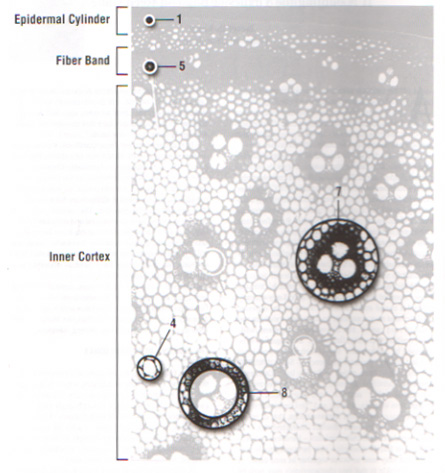
Microphotograph of cross section of clarinet reed (Arundo donax). Selected features are indicated by numerals: (1) epidermal cell, (4) large, thin-walled parenchyma cell [ground tissue] in inner cortex, (5) lignified cell in fiber band, (7) large vascular bundle in inner cortex, (8) ring of lignified cells surrounding vascular bundle. Photograph courtesy of Marilyn S. Veselack.
Bassoonists often call the first of these the “rind” or “bark,” and the third the “pith.” In between, the second (the fiber band) is often recognizable as a thin brownish ring. (In the language of botanists, “sclerified” means “hardened”; “sclerenchyma” cells are hardened, or supporting tissue; “parenchyma” are softer tissue.) The strength of the two outer rings allows the reed maker to form a stable tube for the bassoon reed. On the blades of the reed, these layers are profiled or scraped away to expose cells of the inner cortex, which are flexible enough to vibrate easily.
The middle and inner layers include bundles of vessels that supply food and water from the roots to the stem.6 Donald J. Casadonte, a chemist and clarinetist, provided a useful analogy, comparing the dermal tissues to an animal’s skin, the parenchyma or ground tissues to muscle and/or bone, and the vascular to vein tissue.7 He also explained that sclerenchyma cells begin as vascular cells, but at a later point develop thicker walls, so that they then serve as a load-bearing tube.8 The vascular tissue of the inner cortex is important because the sheathing of the vascular bundles, when of sufficient age and development, contains fiber that gives a very unusual stiffness that allows vibration in all planes. Numerous researchers have identified the inner cortex as the source of these favorable characteristics. Kolesik et al. found that of anatomical characteristics that measurably affect the performance characteristics of clarinet reeds, all “are attributed to … the vascular bundles in the inner cortex…. The good reed … had vascular bundles with a higher proportion of fiber and lower proportions of xylem and phloem…. [T]he good reed had a larger fiber area, and a higher proportion of vascular bundles with a continuous fiber ring….”9 The findings of Kolesik’s team corresponded to results obtained by Marilyn Veselack, Jean-Marie Heinrich, and a team led by H.C. Spatz.10
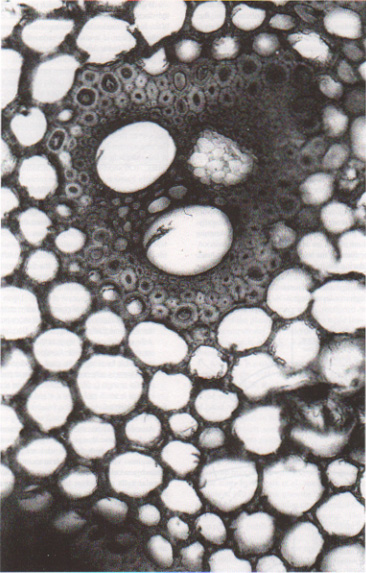
Three vascular cavities surrounded by lignified sheath, magnified 200 times. Researchers have suggested that the lignified sheathing is the main source of stiffness in bassoon reeds. Photograph courtesy of David Rachor.
Casadonte explained three essential virtues of Arundo donax. First, “moderate density combined with a high modulus makes Arundo donax unique as a reed material.”11 The “modulus” to which he refers is a physical measure of the stiffness of solid materials; a higher modulus indicates greater stiffness. In the instance of Arundo donax, the stiffness results from the high proportion of fiber that Kolesik et al. described.
A second characteristic of Arundo donax that Casadonte identified
is of great significance to bassoon players: “In true woods there
is only one naturally dominant plane of material strength, but in Arundo
donax, three planes are of equal strength.”12
In bassoon reeds, the fibers at the back rail of the blades have been
rotated (during the forming process) almost 90 degrees away from those
at the center of the back. Meanwhile, fibers at the tip have been rotated
in the opposite direction, though to a lesser degree.
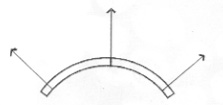
Figure 3a: Shows three radii drawn through a piece of bassoon cane before forming.
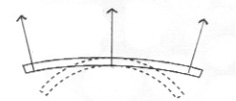
Figure 3b: Shows how the radii are rotated at the reed's tip after it has been flattened in the forming process.
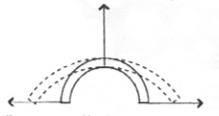
Figure 3c: Shows how the radii are rotated at the reed's back after it has been rounded in the forming process.
Without equal flexibility in each plane of vibration, the vibration would be much less predictable, especially in higher modes of vibration (that is, overblown pitches). Even if it could be successfully formed, a wooden reed, with flexibility only along its longitudinal plane, might vibrate chaotically, if at all.
This remarkable flexibility in all planes is only possible because the fiber cells are largely lignin. Lignin has viscous characteristics of vibration; that is, it vibrates more like a fluid than like a solid. This will come as a surprise to the layman, because lignin is also the source of the hardening or sclerification of cell walls over time. In a typical reed for the modern, German-system bassoon, the lignin is present mostly in the sheathing of the vascular bundles of the inner cortex. (On short-scrape reeds, including some reeds for early bassoon and many oboe reeds, there is a second source of lignin in the fiber ring. This middle layer is not removed from such reeds.)
The viscous characteristics of lignin are such an essential feature of the bassoon reed that we should hear more of Casadonte’s explanation:
The last major chemical component (20% to 40%) of Arundo donax is lignin (from the Latin word for wood). This highly complex gummy filler substance is formed from dead plant cells, and usually occurs as a result of the aging process of plants. Lignin protects older plants from pathogens and water, stabilizes the cell wall matrix, and gives viscous shock protection and some plasticity to the plant…. [T]he presence of the rather amorphous lignin in the relatively flexible cell wall structure of Arundo donax may be responsible for changing the plant stem from one in which there is only one naturally dominant plane of material strength (a situation common in true woods) into one in which each of the x, y, and z planes are of equal strength.13
Arundo donax has the remarkable physical trait of being visco-elastic; that is, it has vibrational characteristics typical of both liquids and solids. Whereas lignin has viscous characteristics, the walls of parenchyma cells have elastic characteristics, and the vascular cells themselves have characteristics somewhere between viscous and elastic.14
Casadonte identified a third physical virtue of Arundo donax: when made into reeds for musical instruments, it damps quickly. That is, the vibrations caused by an applied force tend to end quickly, when compared to wood. (This might at first seem to be a drawback, since vibration is the essence of musical sound. But in practice, the force [the standing wave, or vibrating air column] is applied continuously, so that the sound is sustained as long as the player wishes.) The faster the reed damps, the better control the player has over the vibration, avoiding “destructive interference from cycle to cycle.”15 The damping characteristics are a property of the ground tissue of the inner cortex. (The inner cortex also contains hemicellulose, which absorbs water when a reed is soaked. This important characteristic is discussed below.)
Important Physical Characteristics of Arundo Donax
|
2. The Growing of Arundo Donax
Several aspects of the growing and harvesting of Arundo donax have been claimed to affect reed quality. The climate, soil, spacing, irrigation, and fertilization are significant, as is the age of the stem at harvest and the timing of the harvest during a suitable cold month. Arundo donax sprouts twice within a calendar year, with only the earlier growth being suitable for reed making, as Dominic Weir explained:
“Male” cane starts growing in the spring – it is hard, nonporous, and is the best cane for reed making. The “female” cane starts to grow later, in July – it is soft and porous, thus it is inferior to the “male” cane. The reason for the “female’s” inferiority is due to its rapid growth, which results in a coarser wood and is less resistant to winter frosts. The distance between the joints is longer.16
Bate made a related point, implying that reed cane should not grow too fast. He emphasized that the climate in southeastern France, the traditional source of cane for reed making, encourages slower growth: “The art of growing cane for reed making seems to lie in harvesting the plant at the right degree of immaturity, and the Var climate, constantly sunny, yet tempered by the dry and cold mistral, contributes to this very markedly.”17
The proper maturity is two years’ growth, according to Daniele Glotin, director of a prominent cane distribution company.18 Glotin’s firm owns both planted and wild crops; she noted that controlled planting is slow and expensive, but allows for better access (so that culling is easier, leading to better light for the remaining plants) and controlled irrigation, so that accidents of nature do not damage the crop.
Soil, light, rainfall, and temperature comprise an environmental system that French winegrowers refer to as terroir. Aspects of the climate may vary somewhat from year to year, but they do so within limits indigenous to the terroir. Terroir is likewise important in the growing of Arundo donax, to the extent that the Glotin firm can produce oboe cane in some fields and larger cane (for bassoon, clarinet, etc.) in others, simply because the two terroirs are significantly different.
Scientists have given two important reasons why the cane stem needs to reach a certain stage of development before harvest. One is that lignin, which gives cane the desired stiffness for vibration, develops only over time. “Stems in a more mature state of development have more parenchyma cells with very thick walls. Fiber [lignin] cells also develop extremely thick walls with age…. As the Arundo stem grows older, the thickness of the cell walls increases.”19 Even within a single plant, the older portions have dramatically more lignin than younger portions: “Joseleau et al. found, as to be expected, that there is also a correlation between age and lignin concentration. The concentration of lignin increases about ten-fold as one goes from the top (younger portion) of the stem to the bottom (older portion).”20
A second factor dependent on age is the concentration of hemicellulose, which stores water when a reed is soaked. (The primary hemicellulose, arabino-4-O-methyl glucuronoxylan, is abbreviated as AMGX.) “[L]ater harvesting of Arundo donax leads to stable concentrations of AMGX in the plant stem (about 25%). Alternately, younger stems, sectioned only near the base of the plant, show the same trend [toward stable concentrations].”21 Underdeveloped sections may have too much AMGX, leading to excessive water absorption by the reed.
It’s also possible for cane, especially if found growing in the wild, to be too old for optimal reed making. John W. Reid wrote that “cane that has aged in the weather for a long time loses the characteristics of good cane.” Cane older than two years will tend to have more lignin in the fiber ring and vascular bundle sheathing, which some makers might find advantageous, but others might not.
Even if a wild crop receives (atypically) the advantages of plantation-like spacing and controlled age, the wild crop may produce a lower yield of desirable cane. In the study by Kolesik et al., musicians and scientists compared two different growths from Australia. Both a windbreak and a plantation crop intended for clarinet reeds were planted with similar spacing. The clarinet crop received fertilizer and irrigation, while the windbreak crop received neither. “In comparison to the reeds from the windbreak, the reeds grown in the plantation had a significantly higher proportion of cortical vascular bundles with a continuous fiber ring, and had bundles with a higher proportion and area of fiber….”22 In other words, the average stiffness was higher for the plantation reeds.
Agricultural Factors Significant to Lignin Development in Arundo Donax
|
3. The Harvesting and Curing of Arundo Donax
Knowing the age of the cane at harvest is important, as explained above. The age of plantation cane will presumably always be known. The age of commercially harvested wild cane may also be known, especially if the field is regularly cut clear of all its cane. But an enthusiast who happens upon a patch of wild cane is unlikely to know its age, a difficulty addressed by Reid.23
The time for harvest is mid-December through March; later harvesting is hazardous, because sprouts of a future crop would then be underfoot.24 Reid provided further specifics:
Picking a good day in early January provides good results. Conditions must have been cold for several weeks, which allows the sap in the cane stalk to return to the portion of the plants in the ground. When harvested too early, the sap remains and the cane stalks take on a greenish color, which no amount of drying or soaking can eliminate.25
The curing and seasoning process is important in a chemical sense, Casadonte explained, because it reduces the formerly living stem to a sort of skeleton that is suitable for musical use. “The rigidity of the cell walls of the plant (and subsequent reed) likewise stabilizes, being far too pliable for musical use when first harvested…. Remaining plasma membranes [cell walls] are drained or evaporated, leaving the form, but little of the substance of the original material.”26
A wide range of curing regimens has been reported, ranging from a few months to a few years, with differing sequences of sunning and drying, outdoors or under shelter. The Glotin firm, after exposing bassoon cane to the sun for 10 to 15 days, seasons the cane for up to two years indoors. The firm’s seasoning barn is unusual, according to Daniele Glotin, in that its design allows constant ventilation.27
4. Water Absorption of Arundo Donax
A young bassoonist typically learns in the first lesson that the reed is not expected to vibrate until it has been thoroughly soaked. But why is this so? Scientists have explained that this soaking (or hydration, as they prefer to call it) has important effects on the vibrational characteristics of even a simple rectangular section (a clarinet reed blank, for example) of Arundo donax, tending to lessen the stiffness and lower the vibrating frequency. When a piece of cane is made into a finished bassoon reed, additional effects of hydration come into play.
Casadonte carried out an experiment to measure a vibrational difference between unsoaked and soaked Arundo donax. He first clamped a dry, rectangular sample of Arundo donax and plucked it, obtaining a frequency of 269 Hz. When he soaked the cane sample and repeated the experiment, the frequency dropped to 220Hz. A physicist would say that the modulus of elasticity drops exponentially (that is, the cane becomes more flexible) as the reed is saturated.28 It also gains in mass, as explained below.
Double reeds are subject to additional physical forces. In the special case of a bassoon reed, the swelling of soaked tissues causes the reed’s tip to pucker and the aperture to open to a functional dimension.
When a bassoon reed is hydrated, “free” water is stored within the cellular cavities and vascular tissue capillaries. According to Casadonte, the degree of swelling in a clarinet reed, taken new from its box and then fully hydrated to a level suitable for performance, is greatest in the radial (inside-to-outside) dimension: 16.8%. The reed also swells 7.5 % in the tangential (left-to-right) dimension, and 4.5% in the longitudinal (tip-to-butt) dimension. The weight or mass added by free water is 3.75 %.29 We can assume that the degree of swelling is somewhat less in a bassoon reed, which is gouged thinner; it thus contains a higher proportion of sclerified cells, and absorbs less water.
When the bassoon reed is allowed to dry, the tip aperture will often become partly or fully closed. But hydrating (fully soaking) the reed causes the blades to swell in thickness, increasing the tension and restoring the tip aperture to the correct degree of openness, a critical requirement for correct vibration of the reed. This additional effect occurs because the tip of the reed is thereby placed under additional tension.
Some tension is present in the bassoon reed even before it is soaked. What might be called “dry” tension arises from (1) the deformation of the cane’s natural arc into a flatter arc at the reed’s tip, and (2) the deformation of the natural arc into a much tighter arc at the back of the blade.30 Hydration brings about two new effects that might be called “wet” tension: (3) the hydrated blades increase in thickness; given that movement of each blade is constrained by its contact with the other blade, the swollen blades can only expand by assuming a higher arch. In a secondary effect, (4) the hydrated tube of the reed swells against the brass adjustment wires, and the resulting pressures further influence the tip aperture.
Sources of Tension in Bassoon Reed Blades "Dry" tension is always present, the result of:
"Wet" tension occurs when the reed is soaked, so that:
|
To understand more about the hydration process of the bassoon reed, we need to know a few details of the chemistry of Arundo donax. According to Casadonte, different researchers analyzed five different stems of Arundo donax, with the following results: 42-50% cellulose, 20-24% hemicelluloses, and about 10-20% lignin, ash 4%, silica 1-2%.
Aside from the “free water” stored in a hydrated reed (as described above), a separate quantity of water is bound to the cellulose-hemicellulose-lignin matrix “more or less permanently.” This “bound water,” as Casadonte termed it, comprises 5.98% of the weight of the clarinet reed.
The amount of bound water varies slightly with changes in
atmospheric pressure. As pressure increases, hydration is increased, and
vice versa. Casadonte found that swelling due to bound water could reach
.75% in the radial dimension, .63% in the tangential dimension, and .4%
in the longitudinal dimension.31
(Over its useful life, the reed gradually loses hemicellulose; this loss
decreases the amount of bound water that can be stored. This phenomenon
is discussed below.)
Types of Water Retention in Bassoon Reed Cane
|
It is a truism among bassoonists that even good reeds change over time, from youth to middle age to old age. We are now in a position to ask what chemical and physical changes are at work in this aging process.
About 20-24% of Arundo donax tissue is hemicellulose (various types, but primarily AMGX), the purpose of which is to aid in absorption of water in the living plant. Even in the dead tissue of the bassoon reed, it continues this function. Casadonte reported that the “breaking-in” process for the clarinet reed is largely a matter of the leaching out of AMGX – which has a slightly sweet taste – through repeated use of the reed.
As the reed is played upon, the sweet taste gradually diminishes, and the reed becomes gradually less hydrophilic, until some stable point is reached. This is the point at which the reed is generally said to be “broken in.” These effects are probably due to the loss of hemicellulose in the reed cell wall matrix….32
As the reed continues to age, (1) the loss of AMGX continues. Two other types of chemical breakdown occur:
(2) [C]ontamination of the reed due to salival artifact (amines, glycoproteins, sialic acid, etc.). These breakdown pathways render the material, in effect, more brittle and less hydrophilic…. (3) [S]aliva contains ammonia and other alkali, and these have been shown to induce plasticization [softening] in wood. The result is that the modulus of the material falls (the reed becomes “softer”), and the damping increases (the reed does not maintain sound easily).33
Other factors in the aging process are physical rather than chemical. Casadonte reported that contamination by saliva and oral microflora causes an increase in the mass of the reed’s blades. Casadonte also identified another bacterium strain that adds mass to the clarinet reed’s tip, changes its shape, and reduces its range of motion.34
Unlike the hemicellulose AMGX, lignin does not leach out of the bassoon reed. In fact, lignin is hydrophobic, or water repelling.35 Nor does reed use cause lignin to break down through mechanical faults like cracking and tearing. In this sense, the reed does not simply “wear out,” as Casadonte explained.36
Bassoon reeds are subject to additional types of degradation. Even before the chemical aging process renders a bassoon reed undependable, the reed will suffer from a gradual closing of the tip aperture over time. This is probably due to two factors. One is a gradual deformation called mechano-sorptive creep. Because lignin is amorphous (fluid), it does not always make a perfect recovery from the swelling that results from hydration. Instead, some deformation due to swelling remains, which Casadonte termed mechano-sorptive creep.37
The second is a gradual loss of wet tension, as explained above. This is correctable through wire adjustments, but only partially so. A reed that absorbs less water expands less. The less absorbent blades swell less upon hydration, so that the tip aperture, under reduced wet tension, opens less. In addition, the brass wires lose their original tautness, so that they no longer exert proper pressure on the tip aperture. The player usually re-adjusts the tip aperture by tautening and compressing the wires. This adjustment helps extend the reed’s useful life, but the reed may become less dependable in speech, due to the player’s decreasing control over the tip aperture.
Various chemical remedies to the problem of reed aging have been suggested. Casadonte suggested two new possibilities: (1) a water-based antibacterial rinse (currently available by prescription only), and (2) gas phase infiltration with parylene, a particularly inert polymer.38 Ron L. Fox suggested a treatment based on cross-linking of cellulosic chains to render the cane bio-resistant and wet stable, which improves enzymatic degradation.39 A commercially available product called ReedLife is recommended for clarinet and saxophone reeds; its chemical basis and preservation strategy are unknown.
6. The Virtues of Desirable Cane According to Reed Makers
We are now in a favorable position to review various cane quality tests, most of them well known to bassoon reed makers. We are not particularly interested in agreeing or disagreeing with a particular test or author – the authors speak for themselves, and different preferences are possible even among reed makers who agree on terminology. Nor is it necessary to list every author who has ever described a particular test. Our goal is rather to enumerate many of the different tests and qualities that various authors have described, and to ask what relationships, if any, exist among them. (We will omit simple inspections relating to dimensions in the workpiece; these characteristics pose no particular challenge for the experienced reed maker.)
Often cited as a desirable quality, hardness is sometimes defined as “the resistance of metal [or other materials] to indentation by an indenter of fixed shape and size under a static load or to scratching.”40 In this vein, Carl Almenräder recommended what he called the “finger nail test” of cane hardness:
Run the thumbnail over the bark of the cane following its curvature, and observe whether with normal pressure any mark is impressed upon the cane. If none is left, you can be sure that the wood is too hard.
Almenräder preferred softer cane, although many of his contemporaries preferred harder cane, as he made clear as he continued:
Although many will reply that “The hardest, most solid cane is most suited to the making of bassoon reeds,” I will answer that if such reasoning were followed to its conclusion, apparently even better reeds could be made from wood that is harder and more solid than cane. Personally, I would rather make my reeds out of a piece of pine wood than use the hard cane which some bassoonists use.”41
But many modern authors, including Reid, have preferred a harder result from this test:
The mark should be difficult to make and should not go very deeply into the surface. As an example, the mark that the thumbnail can make on a pencil is much too deep, and cane which allows such a deep mark will be too soft and mushy to make a decent reed. The mark is like the indentation that can be made on hardwood, and is not extremely visible but can be felt with light thumbnail pressure.42
Various meters commercially available for this task measure the penetration of a spring-loaded probe into the inner surface of gouged cane. But which is significant, the hardness of the inner surface, or of the outer surface?
James M. Poe noted that he tested cane hardness with such a meter.43 Although he did not specify, it was apparently the inside surface Poe tested (he was able to conclude that “cane increases in hardness as it gets closer to the rind”). Poe did not specify whether he was testing the cane wet or dry.
Lawrence J. Intravia’s hardness test differed in some respects from Poe’s. He tested the cane both wet and dry, and he, by contrast, measured the outer surface “because of the extreme softness of the pitch [pith] of the cane.”44 It may be that the testing equipment available to Intravia before his death in 1973 – a Rockwell Superficial Hardness Tester, which had a “diamond cone indenter” with a minimum load of 15 kilograms – was not sensitive enough to test the softer side of bassoon reed cane.
A cruder version of Intravia’s hardness assessment is sometimes called the “stab” test: the assessor probes the outer surfaces of successive pieces of cane (usually wet and gouged) with a knife point or stylus, making a subjective rating or ranking of the resistance that each piece offers.
It is an irony that many of these hardness tests, which address the outer surface of cane, measure a part of the cane that will be trimmed away and discarded in the making of a typical reed for the modern, German-system bassoon. Yet testing for hardness on either surface of gouged cane seems to yield useful information to the bassoon reed maker. This may be because the fiber band can be “felt” through the epidermis. The fiber band, made up of lignin, apparently develops at the same rate as the vascular sheathing in the inner cortex. Thus the hardness of the fiber band may be correlated with the hardness of the inner cortex, which will make up most of the vibrating blades of a bassoon reed.45
Density is “the mass of a substance per unit volume.”46 In Lacy’s flotation test, numerous equal-sized pieces of dry cane in the gouged state were floated in a water-filled cylinder, the result being that some sank further into the water than others. The percentage of submerged length was noted for each. The further a piece sank, the higher its density or specific gravity. Lacy did not explain how he tested the same pieces for hardness, but he went on to report “a strong correlation” between the hardness test and the density test.47 Jean-Marie Heinrich described a more elaborate density test that employs a pycnometer (a vessel designed for measuring density) and a precision-weight scale.48
A perceived correlation between density and hardness dates back to the early 19th century at least. Almenräder’s treatise on bassoon playing and reed making was published in 1842 with parallel German and French texts. When “hart” (hard) appears in the German, “dense” (dense) appears in the French, no further explanation having seemed necessary to the publisher.49
9. Flexibility, Elasticity, Resiliency, and Stiffness
These concepts are closely related. The word flexible is “applicable to anything capable of being bent … without being broken and with or without returning of itself to its former shape.” Its opposite is stiffness, which is “the resistance (as of a structural beam) to bending under stresses within the elastic limit, with no emphasis on return to the original shape.”
Between these opposites are elasticity and resiliency. “Elastic indicates ability to stretch, expand, or take on new shape under pressure, usually with return to an original shape or position after pressure is withdrawn.” The word can be troublesome, because some uses focus on the aspect of flexibility, while others focus on the return. Resilient, in contrast, “stresses an ability to spring back and recover shape with the removal of pressure.”50 It is thus unambiguous on the issue of return.
Intravia identified another quality that he called recovery. He flexed a piece of cane for five minutes, then measured its ability to spring back to its original shape. This might be taken as a quantitative measure of resilience. But what Intravia measured under this name was not a realistic simulation of the musical vibration of a bassoon reed, the frequency of which would be many flexings per second. (Such a test might instead have shed light on the aging process of a reed, although this has yet to be determined. Perhaps Intravia’s “recovery” is resistance to mechano-sorptive creep, as discussed above.)
To test stiffness, Intravia clamped gouged pieces of cane at one end in a horizontal position and applied a downward bending force. He found that “in general, the rank orders follow a similar pattern when tested wet and dry. This fact suggests that perhaps one testing might be sufficient.”51 Interestingly, he also found that the exceptions – certain pieces which tested harder when wet than when dry – were obtained from the same source.
Reid described another popular assessment, which might be called the torsion or twisting test.
Hold the soaked cane in both hands at the very ends and gently twist to about a 45 degree angle…. The cane should be flexible, not rigid, and it should spring quickly back into original shape.52
Poe quantified this same sort of test by clamping one end of the test piece, using a constant weight to apply torsional force to the other end, and measuring the angle of deflection by protractor. (He did not specify whether the test piece was wet or dry.)53 An important requirement for these tests of flexibility is that the test pieces be closely isomorphic – that is, of identical length, width, thickness, and curvature. Otherwise, the results will be skewed by unintended variables.
A related test of flexibility might be called the “pucker test”: a finished reed is soaked, and the blades are compressed from the sides above the first wire. A reed whose aperture flexes open several times its normal width is judged to be too flexible (and possibly not resilient enough), while a reed whose aperture can be flexed open only a little further than normal is judged to be acceptable cane. By this late stage, unfortunately, most of the maker’s labor has already been expended, whether the cane is desirable or not.
Lacy briefly mentioned the “dynamic” test, which involves dropping dry pieces of gouged cane onto a hard surface and noting the resulting pitch.54 This is a way of identifying the resonant frequency of the cane segment, as a physicist would call it. Lacy did not go into specifics, but conventional wisdom is that the higher the resonant frequency or pitch, the more desirable the cane tends to be. As with the flexibility tests, the test pieces must be identical in all dimensions, so that results will not be skewed by unintended variables.
The color of the cane on both outer and inner surfaces is often said to be an indicator of quality. Vernon Read, for example, considered that a yellow outside was ideal, while purple-yellowish is “usually a sign of good aging.” Greenish-yellow cane “may be great with proper aging, while brown “may be old, past prime, though worth a try.” Deep green is “not good, needs another year,” while white is “dying” and gray is “dead.”55 Casadonte explained some of the scientific background for color analysis: “As cane ages, the relative amount of xyanthophyll (which is yellow) increases and the amount of chlorophyll (which is green) decreases.” Brown discoloration on the epidermis of the cane is harmless tannin, not leaf marks, he also explained.56 Color is primarily a means of verifying that proper harvesting or curing procedures have been observed, something many cane purchasers take for granted.
When the reed maker is at work, the cane may offer greater or lesser resistance to the tool or machine (a gouger or profiler, for example). Reed makers appear to favor a more resistant feel. Reid said that:
The scrape of the gouger blade makes the final test. The first few passes of the blade remove the membrane and soft fibrous materials. Resistance of each successive blade pass should increase until the desired thickness is achieved. Watch the grain carefully as the last few passes are made. The removed curls of cane should have even and compact grains.57
More than a century before Reid, Almenräder had noted that desirable cane had a certain tenacity, or resistance to the gouging tool.58 This is of interest, because Almenräder professed to dislike hard cane. Thus this quality appears to be separable from hardness.
Cane Characteristics and Tests Hardness (Outer Surface)
Hardness (Inner Surface)
Density (Specific Gravity)
Stiffness or Flexibility
Resonant Frequency
Color
Resistance to tools
|
Scientific researchers are united in their findings that stiffness is desirable in reed cane, and that it results from a specific anatomical feature: the fiber sheathing of vascular cell bundles in the inner cortex. The favorable development of this anatomical feature has been linked, moreover, to specific agricultural practices, including spacing, irrigation, fertilization, climate, age of the stem, and age of an internode within the stem. This is all worth knowing, even if the average reed maker ultimately has to trust a commercial grower to ensure that the best agricultural decisions have been made.
While scientists have focused on the quality of stiffness, many bassoon reed makers have tended to test for either hardness or flexibility. These three concepts are separable, even if intuition tells some bassoonists that the first two are similar, while the last is their opposite. But bassoonists are not unanimous in this intuitive belief. Intravia was exceptional in attempting to test separately for hardness, stiffness, and “recovery,” which was a sort of resiliency. He concluded that “cane that tested the softest was also the least stiff and had the greatest amount of recovery.” In other words, recovery was negatively correlated with hardness and stiffness. Intravia preferred cane with these qualities. Surprisingly, Intravia also concluded that “cane in which there is a positive correlation between hardness, stiffness and amount of recovery makes the best reeds regardless of the strength desired by the maker.” This apparent contradiction is not easy to explain, although Intravia questioned the validity of his hardness test, “because the structure of cane makes it impossible to produce consistent readings using the Rockwell Superficial Hardness Tester.”59 Perhaps a latter-day researcher equipped with a suitable hardness tester and a flexibility test more analogous to performance conditions will be able to duplicate Intravia’s results.
The importance of these conceptual distinctions and experimental methods becomes clear when we compare one of Intravia’s results with one of Poe’s. After culling out “the extreme ends of the distribution which are too soft or too hard,” Poe then concluded that “cane that is softer requires less flexibility to make a good reed whereas harder cane requires greater flexibility.”60 This seems to be the opposite of a finding by Intravia: “Cane may be discarded if it tests either stiff and soft, or hard and flexible.”61
Researchers and reed makers have explored other correlations. Lacy’s experiment allowed him to establish a correlation between hardness and density in cane. Anecdotal experience suggests that stiffness might be correlated with a higher resonant frequency, but a controlled scientific investigation would be desirable. Carefully designed experiments and equally careful reporting of results may eventually establish beyond question the strength of correlation between any two of the qualities mentioned. This would be an important step forward for reed makers.
No matter what tests are performed, different bassoonists will not always prefer the same pieces of cane. There is a significant reason for some of this dissent: material (cane) is only one of many elements of bassoon reed design. Different bassoonists make long reeds or short, narrow reeds or wide, with thickly or thinly gouged cane, with or without a collar, and with a blade shape that may have straight, convex, or concave rails. This polymorphic profusion of options for the bassoon reed contrasts sharply with the isomorphic regularity of clarinet reeds, which have few dimensional variables. Such stylistic options are in addition to the environmental variables shared by single- and double-reed players: climate, altitude, performance space, ensemble taste, and the peculiarities of the player’s own instrument.
Copyright 2003 by James B. Kopp
I’m grateful to Professors Donald J. Casadonte, Frank A. Morelli, and David J. Rachor, who read this article in draft and provided numerous useful suggestions.
1. Edwin V. Lacy, “Testing
the Density or Specific Gravity of Bassoon Cane,” The Double
Reed 24/4 (2001): 45.
2. Lawrence J. Intravia, “The
Effects of Hardness and Stiffness of Bassoon Cane upon Performance of
the Reed,” Journal of the International Double Reed Society
6 (1978): 30-46.
3. James M. Poe, “Cane Hardness
and Flexibility: Related Measurements Leading to Better Bassoon Reeds,”
The Double Reed 26/2 (2003): 60-64.
4. With the advent of injection molding,
a bassoon reed of plastic became a tempting possibility. In practice,
though, plastic reeds are largely favored by students and bassoonists
in tropical climates, where they apparently resist mold.
5. Peter Kolesik, Alan Mills, and
Margaret Sedgley, “Anatomical Characteristics Affecting the Musical
Performance of Clarinet Reeds Made from Arundo donax L. (Gramineae),”
Annals of Botany 81 (1998): 151.
6. “The fiber band includes
small vascular bundles evenly distributed along its outer edge. The inner
cortex comprises the bulk of the stem tissue and is made up of a mix of
vascular bundles and parenchyma cells.” Kolesik et al., 153.
7. Donald J. Casadonte, “The
Clarinet Reed: An Introduction to its Biology, Chemistry, and Physics,”
(D.M.A. diss.: The Ohio State University, 1995), 82.
8. Casadonte, 92, noted that “fiber”
has a specific botanical meaning, and that the so-called “fiber
band” can also be made up of different cells called sclereids. But
Veselack, Kolesik, and others have preferred “fiber band,”
and readers can expect to encounter the term.
9. Kolesik et al., 153.
10. “Our finding … corresponds
with the trends obtained by Veselack (1979)…. Heinrich (1979), analyzing
bassoon reeds, found that if the fiber ring around the vascular bundles
was too thin, the reed produced a flat tone…. Using Young’s
moduli, Spatz et al. (1997) showed that the extraordinary stiffness of
Arundo donax wood was due to the high amount of fiber in parenchyma on
the inner cortex. This stiffness is considered the basis for a good acoustical
performance of the reed in the clarinet (Backus, 1961).” Koselik
et al., 154.
The studies to which Kolesik referred were: Marilyn S. W. Veselack, “Comparison
of Cell and Tissue Differences in Good and Unusable Clarinet Reeds”
(D.A. diss: Ball State University, 1979); Jean-Marie Heinrich, “The
Bassoon Reed,” Journal of the International Double Reed Society
7 (1979): 17-43; H.. C. Spatz, H. Beismann, F. Brüchert, A. Emanns,
and T. Speck, “Biomechanics of the Giant Reed Arundo donax,”
Philosophical Transactions of the Royal Society of London B 352
(1997)” 1-10; J. Backus, “Vibrations of the Reed and the Air
Column in the Clarinet,” Journal of the Acoustical Society of
America 33 (1961): 806-09.
11. Casadonte, 209. “According
to some experimental work done by Benade together with Walter Worman and
Daniel Wright, the particular virtue of Arundo donax for reed making lies
in its high ratio of longitudinal stiffness to density, together with
great transverse flexibility at appropriate thickness.” Philip Bate,
The Oboe, third ed. (London: Benn; New York: Norton, 1975), 21.
12. Casadonte, 181.
13. Casadonte, 175, 181.
14. Casadonte, 106.
15. “[T]he ground tissue may
be modeled as an extended imperfect lattice, such as one might see in
a crystal…. [B]ecause of the simple, nearly regular ordering pattern
of these hollow/filled [with lignin] unit cells, we suspect that energy
is much more efficiently dissipated throughout the ground tissue or Arundo
donax than in more amorphously structured wood ground tissue. This efficiency
is likely one reason for the unusually high damping coefficient of Arundo
donax (more than ten times that of wood) – the energy resulting
from an impulse applied to the ground tissue is siphoned away from the
initial site of impulse at a very high rate.” Casadonte, 103 and
106.
“The amorphous material (typically concentrated around the vascular
tissue in the form of lignin), is essentially a superviscous fluid, and
stores the applied stress, much as a dashpot [shock absorber] might store
mechanical energy, or a capacitor store electrical energy. The crystalline
or ordered cellulose lattice, on the other hand, is essentially elastic,
responding as a spring might to mechanical stress, or a resistor might
to an electrical stress.” Casadonte, 279.
16. Dominic Weir, “Information
on Growth and Characteristics of Cane,” To the World’s
Basoonists 2/2 (1971): 7.
17. Bate, 22.
18. “Interview with Daniele
Glotin,” The Double Reed 25/1 (2002): 106 (reprinted from
Scrapes International 2 (1999): 12-19).
19. Veselack, “Arundo donax,”
26.
20. Casadonte, 180, citing Jean-Paul
Joseleau, Gerhard E. Miksche and Seiichi Yasuda, “Structural Variation
of Arundo donax in Relationship to Growth,” Holzforschung 31,
no.1 (1976): 19-20.
21. Casadonte, 160, 175.
22. Kolesik et al., 154.
23. John W. Reid, “Cane Selectivity
from the Field to the Gouger,” Journal of the IDRS 11 (1983):
17-18. Vernon Read, The Bassoon Reed: Stalk to Bocal (San Jose,
California, 1990), 9, said that color and response to the curing process
could help confirm a suitable age.
24. “Interview with Daniele
Glotin,” 106.
25. Reid, 17.
26. Casadonte, 31, 32.
27. “Interview with Daniele
Glotin,” 108. Vernon Read, 9, aged stems outdoors in a “teepee”
pile for three months, then on outdoor racks another three to four months.
Bate, 21, reported a longer process: “The stems are cut when still
green … and gathered into conical stacks and left to season in a
cool, dry place outdoors. During the seasoning, which usually takes two
years but may last up to four, selected stems are carefully watched and
are turned at intervals, as they develop a rich golden-yellow color with
various degrees of mottling.”
28. Casadonte, 255, 284. This test
did not involve a bassoon reed, nor was the excitation mechanism the same
as blowing a reed, but the trend, at least, would presumably hold for
a bassoon reed in normal use.
29. Casadonte, 246, 244.
30. For a fuller explanation of
this topic, see James B. Kopp, “Physical Forces at Work in the Bassoon
Reed,” The Double Reed 26/2 (2003): 77-78.
31. Casadonte, 187, 246.
32. Casadonte, 168.
33. Casadonte, 233.
34. Casadonte, 233, 238.
35. Casadonte, 106.
36. Casadonte, 232.
37. Casadonte, 252, 256.
38. Casadonte, 240-41.
39. Ron L. Fox, “The BFC Cane
Treatment for Prolonging and Enhancing the Playing Qualities of Reeds,”
The Double Reed 10/1 (1987): __.
40. Webster’s Third New
International Dictionary, s.v. “Hardness,” definition
no. 2.
41. Carl Almenräder, “On
the Making of Bassoon Reeds,” Journal of the IDRS 8 (1980),
23 (translated by Ester Froese from Carl Almenräder, Die Kunst
des Fagottblasens [Mainz: Schott, {1842}]).
42. Reid, 18.
43. Poe, 61, used “a Mitutoyo
Hardness Tester obtained from Reeds-n-Stuff in Annaburg, Germany.”
44. Intravia, 32.
45. Clare Lawton, an oboist and
scientific researcher, observed that the fiber band “shows the most
variation from one internode to the next, suggesting that this may be
a key factor in determining reed quality.” See Karen F. Schmidt,
“Good Vibrations: Musician-Scientists Probe the Woodwind Reed,”
Journal of the IDRS 20 (1992): 33 (reprinted from Science
News 140/24V, 392-94)
46. Webster’s Third New
International Dictionary, s.v. “density.”
47. Lacy, 45.
48. Jean-Marie Heinrich, “Recherches
sur les proprietés densitométriques du materiau Canne de
Provence” (Lyon, France: Alfa Lyon Musique, 1991), 6-12.
49. Almenräder, Die Kunst des
Fagottblasens, 123.
50. Webster’s Third New
International Dictionary, s.v. “flexible” and “stiffness.”
51. Intravia, 45.
52. Reid, 18.
53. Poe, 62.
54. Lacy, 45.
55. Read, 9.
56. Casadonte, personal comm., June
3, 2003; Casadonte, “The Clarinet Reed,” 84 and 89.
57. Reid, 18.
58. Almenräder, Die Kunst des
Fagottblasens, 123.
59. Intravia, 45, 46.
60. Poe, 62-63.
61. Intravia, 45.